I attended the NWeLearn conference in Portland on October 22nd and 23rd. Having attended a few of these events in the past, I was looking forward to the small scale of the event and seeing people I have come to know through participating. And that is what happened. I was able to have many nice conversations with regional colleagues and even visited Powell’s Bookstore again.
At Powell’s, I found a couple more copies of Teaching as a Subversive Activity and one more Amusing Ourselves to Death. I also scored a copy of a book I had read in college by James Herndon titled, How to Survive in Your Native Land. And a really nice edition of Roger’s Freedom to Learn. Yay for bookstores.
After the first two sessions, one immediate takeaway was that they had both clearly used AI generated PowerPoint presentations. They just had that vibe and it was kinda disheartening.
Below are the sessions I attended. I have included the session description, some brief notes and any resources. I will say that the event used “Sched” as a scheduling platform and presenters could add their materials. Some did and I have included thier resources in where I could. I added my website to my description, but most added the familiar .ppt file to the space.
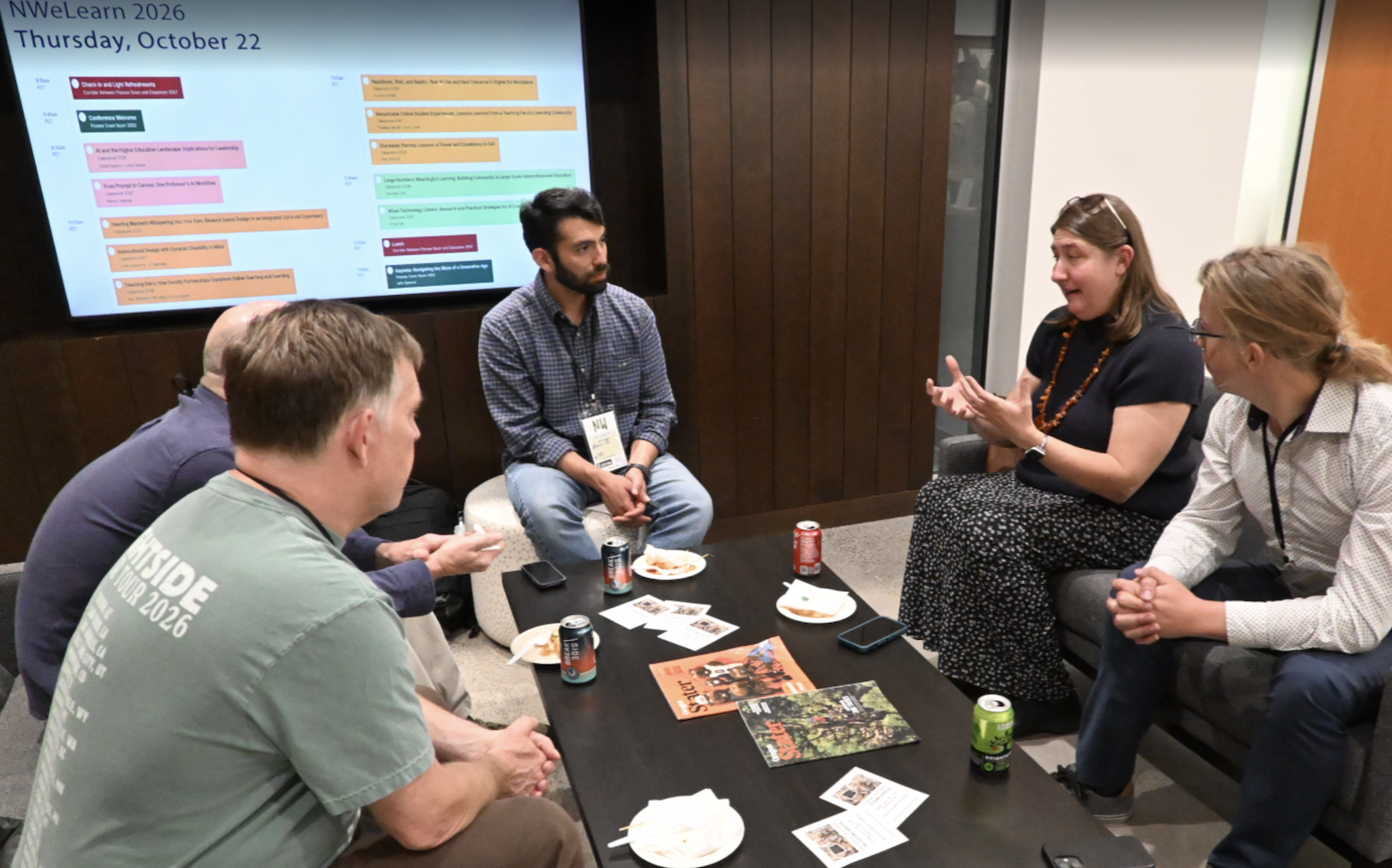
Here are photos from the conference.
Conference Sessions I Attended
From Prompt to Canvas: One Professor’s AI Workflow
What does it actually look like when a community college professor uses AI as a daily teaching tool — not as a gimmick, but as a genuine workflow partner? In this session, I’ll share how I’ve integrated AI tools into three core areas of my work: course design, Canvas development, and professional productivity.
With our upcoming “Sharing Our Stories” event I was interested in seeing how other faculty are using AI in course building. This faculty was doing just what Charlie will be sharing. He was building assignments, or the most part, and some other consumable content. But largely he focused on how it helped him define learning objectives and making those visible. While the .ppt he used for the presentation was AI generated, most of what he shared about his work in Canvas was making prompts for discussions and assignment language.
I ended up talking with this guy a few times over the breaks. At the community college is also in charge of some of the PD offerings the other faculty receive.
Teaching Pairs: How Faculty Partnerships Transform Online Teaching and Learning
This session explores how Lane Community College and Portland Community College use Teaching Pairs to support professional development for faculty who teach online. Through peer observation, structured reflection, and collegial dialogue, Teaching Pairs creates opportunities for instructors to share practices, deepen their understanding of online teaching, and learn from one another in a supportive, non-evaluative environment.
I loved the idea of this of course, but my first question to the presenters was, “Were they connecting the Lane and Portland faculty together? They said no, but will consider that in the future. I thought that was what the presentation was going to be about. Not so. Each school was pairing up instructors, and the schools had slightly different ways of going about it. The session also featured Skye Nguyen, the most frequent participant in the PNW Ids meetings.
Here is the Lane Community College Teaching Pairs webpage and here is the Portland Community College site with information about the teaching pairs program.
Remarkable Online Student Experiences: Lessons Learned From a Yearlong Faculty Learning Community
Come hear about our experiment in cultivating Remarkable Online Student Experiences (ROSE) through a professional learning community. Structure, lessons learned, faculty feedback, and how we’re transitioning the content to allow for asynchronous participation. Time to discuss how to support connection and collaboration through intentional conversation is included.
Keynote: Navigating the Maze of a Generative Age
We are in the midst of an AI revolution. For years, we followed a predictable formula: go to school, graduate from college, and climb the corporate ladder. But the ladder is gone, and in its place is a complex maze.
In this keynote, Dr. Spencer will explore how we can adapt as we navigate the new terrain of an AI-driven world.
Here are the slides. All 202 of them 🙂
“Can you just do it for me?”: The Hidden Compassion Work of Instructional Design “Can you just do it for me?” “I know you’ve told me a thousand times where the button is, but I can’t find it.” “What’s this new AI button do?” If you’ve heard these sentences this term — or said them — this session is for you. I’ve done both. And I’ll tell you the harder one to admit: I’m the person with two master’s degrees and a doctorate who still sometimes can’t find the button — and it makes me feel stupid.
This was interesting. The woman presenting had just completed her doctorate and written about the emotional challenges of an instructional designer. I have long joked that my work is a lot of therapy, or psychology. It is true. You don’t see it and it is never mentioned in job skills or yearly reviews. But man, faculty can be pretty emotional around technology challenges and that is where a lot of my work is.
In her session description, she notes, “Drawing on my recently completed doctoral research on compassion in higher education, this session gives you language for the invisible emotional labor you’ve been doing all along. When the same Canvas question gets asked for the tenth time, the conversation isn’t really about Canvas. It may be about what my research calls “professional loss” — the disorienting grief of no longer feeling like the expert in your own classroom — and what looks like a help-desk ticket is actually a bid for compassion in disguise.” Yep, I see that.
Perspectives on Generative AI, Part Deux: Centering Resistant Voices
Last year you were captivated by our talk: Two Totally Legitimate but Possibly Antithetical Perspectives on AI. You laughed. You cried. You hungered for more. And even if you missed it, that’s what you would have felt. Good news, Laura and Jeff are back…. with part deux. (Laura speaks French. Can AI do that?! Well, yes… but Jeff digresses.) Anyway, join us for a preview of our study-in-progress on student resistance to generative AI in education.
These two were fun. One was a real advocate for AI and the other really skeptical. It made for fun banter and it was an engaging conversation.
Create, Design, Inspire: Leveraging AI for Accessible Course Content
Good design and accessible content should be within reach for every educator, and now it is.
Designing visually engaging course content has traditionally required specialized skills, but AI is changing that. In this session, we’ll show how educators, instructional designers, and administrators can use AI tools to create compelling page layouts, develop reusable design patterns, and support accessible content creation for diverse learners regardless of their technical background.
I attended this one primarily because I have met one of the presenters through the Bellevue VR community. Sage Freeman shared some of the work they are doing at Chemeketa Community College during one of the meetings. It was mostly Google Gemini and it was interesting to see their take on how design elements might be included. Also interesting to me is just how much stuff one would have to know and be familiar with to do what they demonstrated. Not many faculty have that depth of knowledge or willingness to get there.
Global Bellevue: International On-Site Pedagogical Research Workshops
This session presents a scalable, innovative model for a faculty training series that integrates an international, on-site pedagogical research workshop with quarter-long curriculum design activities, culminating in end-of-year reflections for both faculty and students.
This is someone I should get to know down in Bellevue. She does a lot of overseas trips and is also one of the first faculty to get involved in the XRlab there. I thought a bit about using VR in COIL courses, but I am not sure we are there yet. I can see XR content in most any class, but it does seem like experiences outside of the country lend themselves to more immersive digital experiences.
Keynote-Led Discussion: Beyond the Ladder: Preparing Students for an AI-Shaped Future
If the corporate ladder has become a maze, how do we prepare students for this reality? This facilitated discussion will explore the distinctly human capabilities students need (including curiosity, judgment, creativity, collaboration, and adaptability).
My session was during the last block of sessions on the last day. Tough. It was wonderful to connect with the people there. And there was lots of free coffee.