You can listen to this lovely music while you wait, in the waiting room.
Message from Our Sponsor: This is not a Zoom Bashing™ conference session. It is however a session about the wise use, and the possible misuse, of the Zoom platform in faculty development opportunities at a university near you.
This began with Zoom school. It began with my kids going to Zoom School. It began not with the amazingness of videoconferencing, but with a pandemic and a culture that values convenience over hard work.
But wait, if you are here in this room, right now, it is time for the Big Giveaway!
Our special gifts today are two copies of the book that could have been written last weekend, but is actually from 1985. That, as you may recall, was before Zoom. Even before iPhones and stuff. We also have a The Grand Prize, a book that should be included in all faculty preparation, Teaching as a Subversive Activity. It was written in 1971, just a few years before 1985. Both books are by Neil Postman.
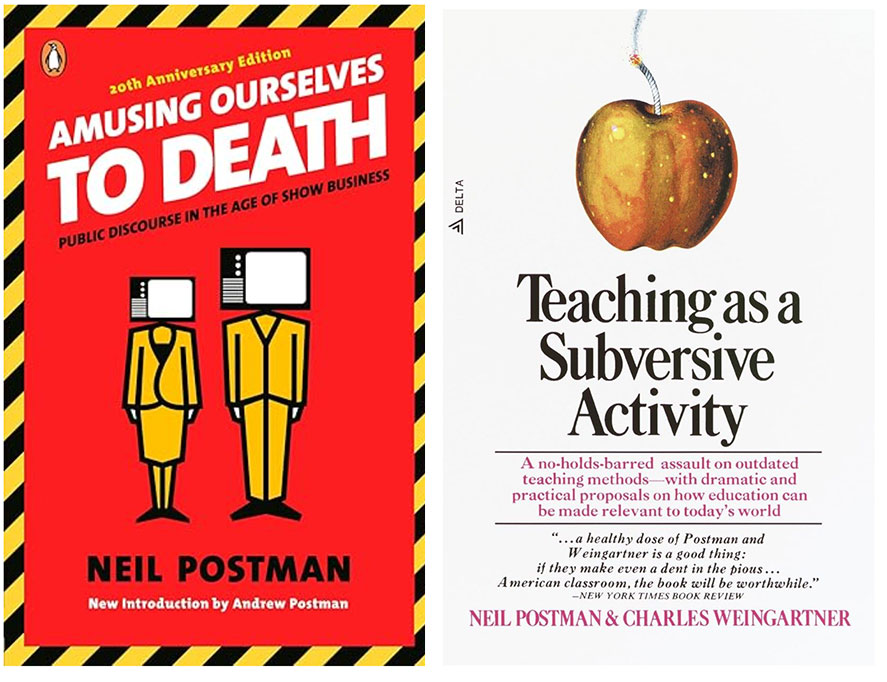
If you are interested in Postman, this hour-long video covers a lot of ground around his ideas in modern society.
Ok! That was fun. Now back to our regularly scheduled programming. Which now, as you read this, is about professional development in Zoomlandia. The title to the session is a play on the show Portlandia, because the conference this was shared live at was/is in Portland, Oregon.
Here is the cute little booklet I made for the conference session.
Like I was saying there at the top of this website page, I watched my kids go though Zoom school. As I noted in the introduction to the cute little book I made for the conference session, “I have been an instructional designer for 21 years. I graduated from Walden University in 2001 after two years of online classes. I was experimenting with “video conferencing” platforms long before Zoom was invented. I have wondered about the miracle of FaceTime and Google Hangouts. I watched my kids attended Zoom School though the pandemic. I have watched our collective culture at the university choose to remain at home.”
I know the latter part of those few sentences sound sad. My challenge here is this, “How do we use Zoom (or any video conferencing tools) wisely in professional development?”
This is the problem I am trying to solve. I do not have an answer, but I do have experiences to share and I feel challenged by them. This image was from a workshop one of our team ran just a couple of weeks ago. There were three presenters, a moderator, and out of 16 participants, exactly two had their cameras on. You have probably been in similar situations. It is Zoom school all over again.
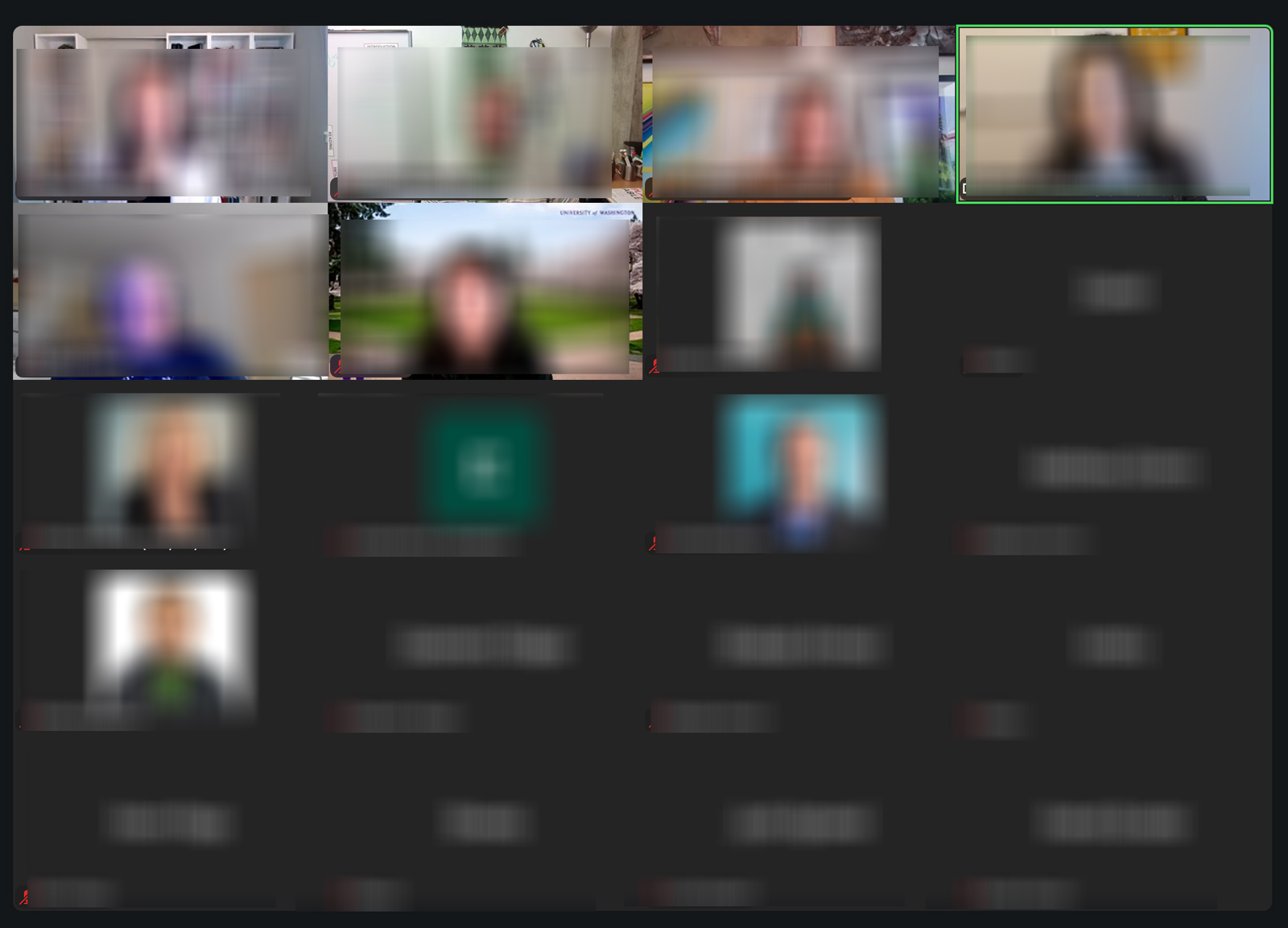
I ask these questions because most of my colleagues do most of the “training/workshop” stuff via Zoom. Not hybrid. Not on websites, but on Zoom and only Zoom. This all came to a head for me in a learning community I was in that was offered entirely on Zoom. The topic was the scholarship of teaching and learning, or SoTL for those who love acronyms, and while it was not immediately clear to me, I could tell over a couple years that it really was not working. At least not for me. The topic I ended up choosing to research was faculty development on Zoom. I use Zoom broadly. Probably more accurate is “video conferencing software.” But that takes too long to say and type, so I’m going to just go with “Zoom.”
As you might imagine there was much written about Zoom School, Zoom Fatigue, and faculty dissatisfaction with teaching Zoom school and administrative meetings held over the Zoom platform. Certainly, almost anywhere that has the 50 minute PowerPoint Zoom session, has been heavily critiqued. Not much love there.
It was harder to find surveys or writing on faculty PD and Zoom, but it is out there. I ended up adding much of it to a Google Notebook and asked a lot of questions. Originally, I was able to find and use 27 articles of various kinds to inform the Notebook. Many were about building engaging and high quality learning communities, but some also addressed more traditional HR style trainings and the classic one hour long workshop from say, IT, or the Teaching & Learning Center.
I made all kinds of things in the Notebook, and over the last year added more and more articles. Fun stuff. I think?
Over time I got away from the learning community, and thinking about Zoom use only in terms of the learning communities, and started to think about it more in terms of the types of training I offered. I also started talking to faculty about how they felt about the use of Zoom in our trainings. As you can imagine, I got a variety of answers.
I added the above mentioned Neil Postman in to the conversation. He would have said these tools change everything. Literally. He said, “A new technology does not add or subtract something. It changes everything.”
Absolutely. Everywhere.
“In courtrooms, classrooms, operating rooms, board rooms, churches and even airplanes, Americans no longer talk to each other, they entertain each other. They do not exchange ideas; they exchange images. They do not argue with propositions; they argue with good looks, authenticity and celebrity.”
— Neil Postman, Amusing Ourselves to Death: Public Discourse in the Age of Show Business
Is this what we are doing. Looking at our own images in Zoom meetings, wondering if our hair looks nice or our backgrounds shows that we have some money? BTW, I learned also through all this that turning off your “self-view” reduced Zoom Fatigue and helps you focus. So does changing the view to “Speaker View.” That way you can look at the one person speaking rather than 10 empty black boxes and six people staring at you.
The Little Book
I added some questions to my little fancy book handout embedded above. I’ll repeat the questions again below and while they are a part of the point here, I think. But, the really challenging is looking forward, to “What we can do.”
QUESTION #1
The “Screen Buffer” & Vulnerability Question
How often do virtual meetings allow us to hide behind a “screen buffer?” We can turn off cameras or mute mics when discussions get uncomfortable. How does that digital distance hinder the deep, vulnerable self-reflection needed for true pedagogical growth?
QUESTION #2
Loss of Informal Connection
When a Zoom meeting ends and everyone instantly logs off, what spontaneous “small talk,” informal bonding, or hallway conversations are we losing that used to build long-term trust and collegial friendships?
QUESTION #3
The Community Paradox
As Faculty Learning Community pioneer Dr. Milton Cox observed that building authentic community virtually is “just so hard to do!” Are our online faculty development sessions building genuine social learning communities, or are they devolving into repetitive, one-way webinars?
QUESTION #4
Faculty Burnout & Screen Fatigue
In an environment where faculty are already overwhelmed by administrative workloads, does defaulting to Zoom for convenience lessen our burden, or does it add to screen fatigue and make faculty development feel like “just another meeting on the calendar?”
QUESTION #5
Strategic Hybrid Meetings vs. Default Habits
Which specific aspects of faculty development genuinely benefit from virtual spaces? Which essential human elements require physical presence and face-to-face interaction?
The questions above where asked in the conference session. But as noted, that was not where I wanted to go. I wanted to address the future, and things we can do. In the little book, I offered just a couple ideas.
- We can reach out to our colleagues in person. We can stop by their office, uninvited.
- We can offer some professional development only in-person.
- We can talk more about the value of in-person events.
- We can advocate for more in-person events.
- We can create spaces that are inviting.
I hope you are not inferring here that I am saying, “Stop using Zoom for professional development activities.” I am not. I am simply trying to make more room for face-to-face interactions where professional development is concerned. I think we have swung too far in the Zoom direction.
So I ask you dear reader, “What are the things we can do to change all this Zoomlandia professional development?” How to we create more opportunities to connect with one another in person? As Neil Postman might ask us, “What is the problem we are trying to solve using this new technology?
During the keynote at lunch today I wondered about the atrophy that might be happening to us related to Zoom. I think of the conversations about loss of learning through my kids Zoom School experiences and how that might relate to faculty loss of learning via Zoom PD. Are there similarities? If so, what might the losses be?
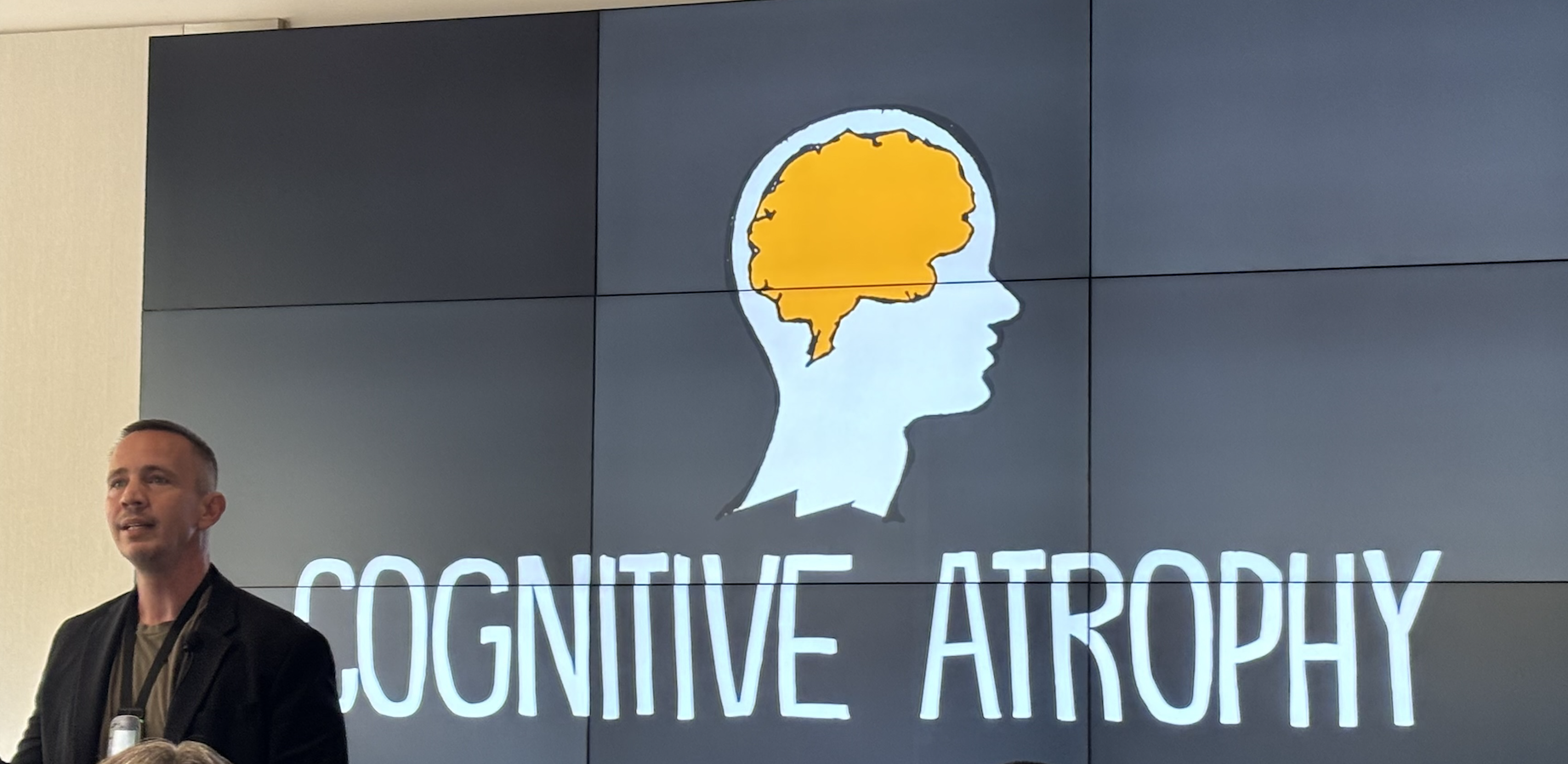
My guesses might be things like a sense of community, or the loss of connectivity to the physical university space. Those are important parts of being an educator.
For now, this is the end of this page. If you have ideas, comments, hopes or worries, please share them here. After the conference I shall return here and add a short video, or written, reflection on what I learned. I hope I remember to ask everyone for a quick, “one thing I can do” audio bite. It would be nice to have some element created by the participants here.
The Next Morning
Well, presenting on the last day, and the last block of sessions is not ideal. But it ended up just fine. Things I did that were different from every other session I attended.
- I handed out little 4 x 4 inch cards with the silly frustrated professor and the day, time, and location of the event.
- I added, “Almost Live Music” and that got more than a few comments.
- I moved all the tables in the room into a circle.
- I had almost live music playing when people walked in.
- I greeted everyone of the nine people that walked into the room.
- I had a gift giveaway to start thing out.
- I wore a sign around my neck for the whole session.
- Everyone got a nice little book and pen.
- I asked for their comments in audio at the end of the session.
What a rebel.
There were 16 people signed up for the session and ten ended up being present. I am not sure how many of them were actually the ones that signed up. This is one thing about Zoom and doing workshops that is currently very challenging for me. We get a few people to sign up, but honestly, less than half show up. We chatted about the challenges of this in class and in PD. It is easy not to show up if it is done in Zoom. That is a thing.
There were two people in the room who work 100% remotely. They see zoom as a blessing. And that is true.
We spoke about how faculty feel teaching Zoom classes and how that is the same/different than doing PD via Zoom. There was laughter at the notion of how faculty so dislike student cameras being off, but they are often guilty of doing the same in PD spaces. True.
We talked about the challenges of getting faculty into in-person PD when they are hardly ever even on campus. Also true.
The end of the day. I asked the participants to share something they will try to do better with Zoom. here is that they said. It is three minutes long. I just handed my phone around the table. How nice.
I live in a small town in rural Ontario. This is where I want to live; I don’t want to live in a city. But this means the whole ‘in person’ thing isn’t available to me, at least, not without an expensive commute. Even when I’m in the city, most of the world is in different cities. I would love to fly to conferences all over, the way I used to do when conference hosts and institutions paid my way, but – as for most people – that doesn’t happen any more.
The problem all this tech is supposed to solve is to connect all those people who aren’t privileged enough to be ‘in the room’ when all that social connection is happening.
I love the social connection part of anything. Like this, right now.
I suppose I can compare my thoughts on this to my feelings about the “hyflex” option in some places. I don’t thing the tech is there yet, or the people skills, to do it. For now, it is just one panicky presenter or teacher and I don’t see much social connection in the the physical room or the video-conferencing space. And honestly, with rare exceptions, I don’t feel socially connected to anyone in a zoom meeting unless it is really small. Like three people.
I think online work can be done well, and have social connections without video conferencing. Online courses don’t need zoom to be meaningful. Here, it seems we survived the pandemic and all we learned was that online classes were zoom classes. I think part of my challenge with it is how it has bled into professional development. Instead of offfering a well done online experience, now it is just a 50 minute lecture on zoom. I am not happy with that. Not as a presenter or a participant…
Todd! My timing is off, you are already in Portlandia. Now I can’t call you on the phone to bug ya. I gotta respect you for always bringing much more than slides to a conference session, eager to hear how it goes.
I’m mixed on laying it all on the feet of The Zoom (yet I constant curse at it for how often I do something wrong, or cant find the control). I’d guess that we’ve settled into the most familiar modality, sitting there pretending to listen to someone drone on while we are looking at another window on our computer. Maybe we’ve not mixed it up enough or tried some different ways of being together. As you know my favorite sessions are the unstructured ones, we do not get nearly enough opportunity to just have open conversation.
I have been in sessions, often ones led by Maha Bali that are much less fatiguing, where the audience gets to do more than maybe just typing in chat where they are from. She does. alot to mix up the pace and flow with breakouts, group work in docs. Getting away from talking over slides is a big improvement in my book. Why is the only way to communicate in groups to show pictures of text? Slides in zoom are a terrible vehicle for information. I love the webinars where they help with a QR code. So I have to hold my phone up to the screen, get a web site that I then might try to get open on the computer I am using? Its nuts.
I do have mixed feelings about trying to force more people to have cameras on. It’s mixed, I know you describe soulless meetings where most are off, but I went to a meeting today where I did not know more than one person, and everyone had their cameras on, even one guy who came in whiole riding a bus in Mexico. Is it the platform or is it us?
I’d like to think we can still do a lot human to human with the sound of our voice. But maybe we should do more than sit at the screen. What if we went outside or down a hallway with our mobiles? I told you recently too about an online group that meets regularly where their activity is a “mini scavenger hunt” there is a prompt to get up from the chairs look around tyhe room and find something like “an object that represents the seasons” “something that suggests change”
I don’t have big answers but I think any platform can be subverted creatively and its too easy to blame the tools rather than a lack of imagination or willingness to go beyond the expected.
Oh I always am in search of that kind of weird German name for the phenomena where you go to speak and have not moved quickly enopug tio unmute and everyone is telling you to unmute. I KNOW I AM I”M TRYING TO CLICK THE DAMNED. BUTTON.
No, I can’t hear you now.
“Is it the platform or is it us?”
It is us. That is why I am giving away Amusing Ourselves to Death 🙂 It is always us.
Here is a link to the article you shared with me the other day.I think it highlights some of the ways where Zoom works.
I think Zoom does not work in places where things without Zoom doesn’t work. Like 120 person classes. Or strait two hour long lectures. But it has also made it easier for people in adjoining office suites meet via Zoom rather than meet in person. I think that is tragic and it happens to me all the time.
“I think any platform can be subverted creatively…” I hope I find a few ways that I can learn to do that from this session.