I took a class called “Group Processes” in college. It was a small class at a liberal arts school and for part of the class we spent three days in a cabin in the woods. It was also three weeks long and we met every day. If I recall, we started with the stages of groups and tried very hard to observe our dynamics and pursuit of understanding looking through that lens. Emotionally, I remember the class. Intellectually, I am not sure.
I don’t recall what the stages we studied were, but I remember “functional” being one of them. I think.
Goes to show how much I recall from school and my “learning.” And I think that is part of the challenge we face here trying to get to “what are we learning as a group? I can hardly address what I am learning by myself!
I can share with you where I have been and reflect them on some of the new learning I may have had at the time. I think that I can safely say that. Beyond that, I am not sure what is actually valuable to others as “What does Todd know and how did he learn it.”
In one of our synchronous meetings, I noted that in preparing to learn to run a marathon there was both physical and mental learning. We shared our thoughts on how our bodies learn, like muscle memory and new synaptic connections, but we also tied that to the mental/knowledge we might come to know as a result. And further, how we might forget what we used to know.
I do think we can say that we can improve our processes as a group and that through time, we might come to all be more skilled. And that we may even be able to demonstrate that.
While I am a firm believer in “learning what you do,” I am also aware of how challenging it is to say with any certainty that “it” or the learning has occurred. More like it is temporarily demonstrated. For example, today I can show you I have learned that two and two equals four. But tomorrow, I may lose that skill. In the context of a group learning, how does one evaluate what is learned? Perhaps we can only say that, “we have experienced.” And that it is good enough to be able to say that.
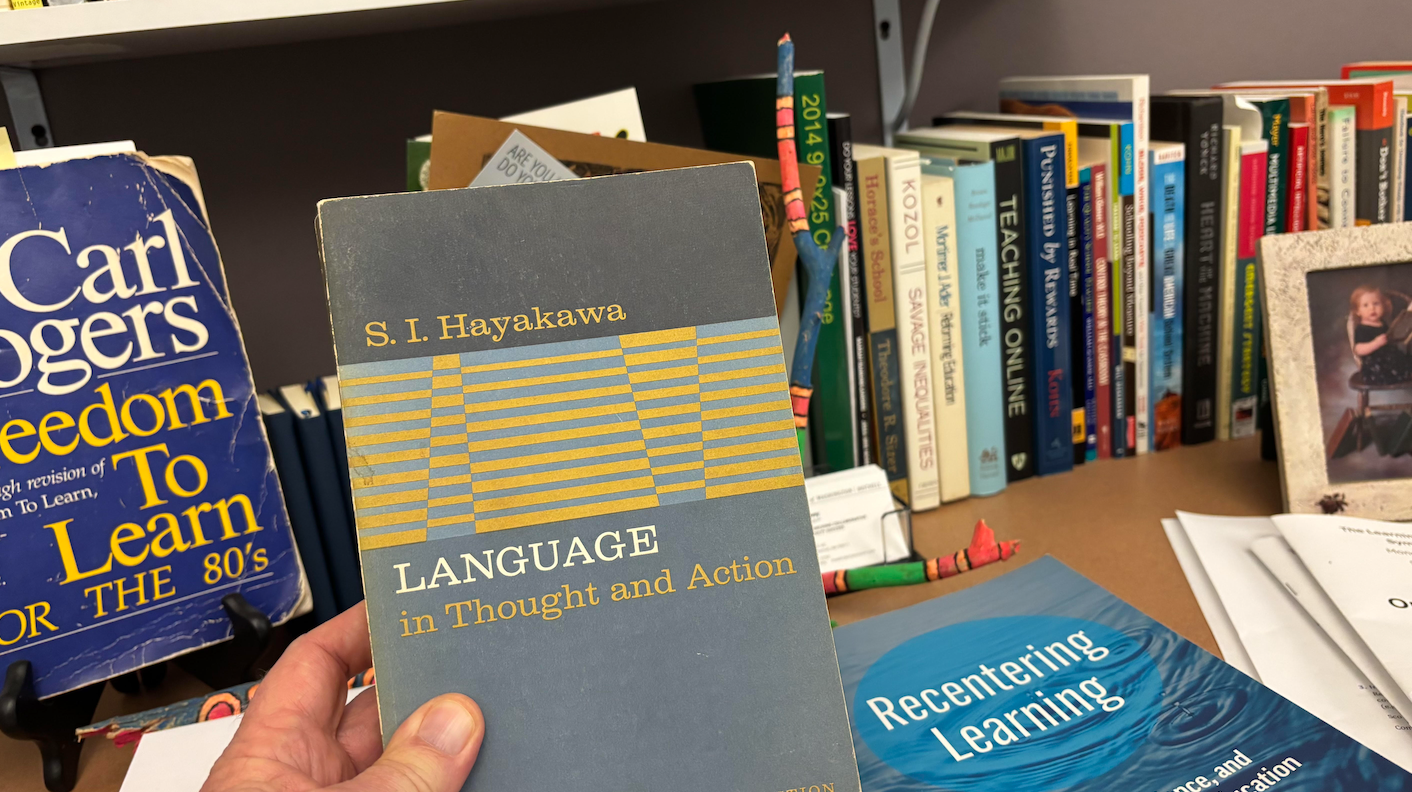
I was reminded the other day about S.I. Hayakawa and a book I read in college called, Language in Thought and Action. I found that book through reading Teaching as a Subversive Activity where Postman and Weingartner use the “map is not the territory” analogy a lot. Anyway, that very idea, and all the variety of ways words work, makes me skeptical that we can really do more than live though the process of experience. Yet, we have to say these things. These are how we communicate, especially in these days of long distances and email.
Like Nahid did in her reflection, I think that we are best as we pay attention to the moment we are in the group and focus on the team and the work at hand. When we are all doing that as well as we can, we might be called a highly functioning group.
Thank you for this reflection Todd, I really relate to it. I also find it difficult to know exactly what has been “learned,” especially in a group, beyond the fact that something was genuinely experienced and shared. Your point that learning may be more temporarily demonstrated than permanently owned feels very true to me. I also think one way to tell the difference between memorised knowledge and real learning is whether we can use it in a new situation, not just repeat it in the same context where we first encountered it. Maybe that transfer is one of the clearest signs that something deeper has happened. I also really liked your point about being present in the group and focused on the work at hand. Sometimes that may be the most honest and useful measure of a well-functioning learning community.
Thanks for stopping by!
I was thinking about our group and what we have accomplished these last couple weeks and you are so right in your personal reflection ( https://www.opennetworkedlearning.se/isabelduarte/2026/04/28/the-work-we-divided-instead-of-sharing/ ) , we may have cooperated a good bit, but not really collaborated. Yet we did spend time together, and as a group we thought and spoke of things. We did collaborate by making something that ties us together. And I think “TIME” is a big challenge for us in the context of this class. There is much to do and only so much time to do it. Given two weeks for each topic makes for a fast pace and that can often result in lower quality of time together and that much needed relationship building.
Glad to see you here! Thank you.